
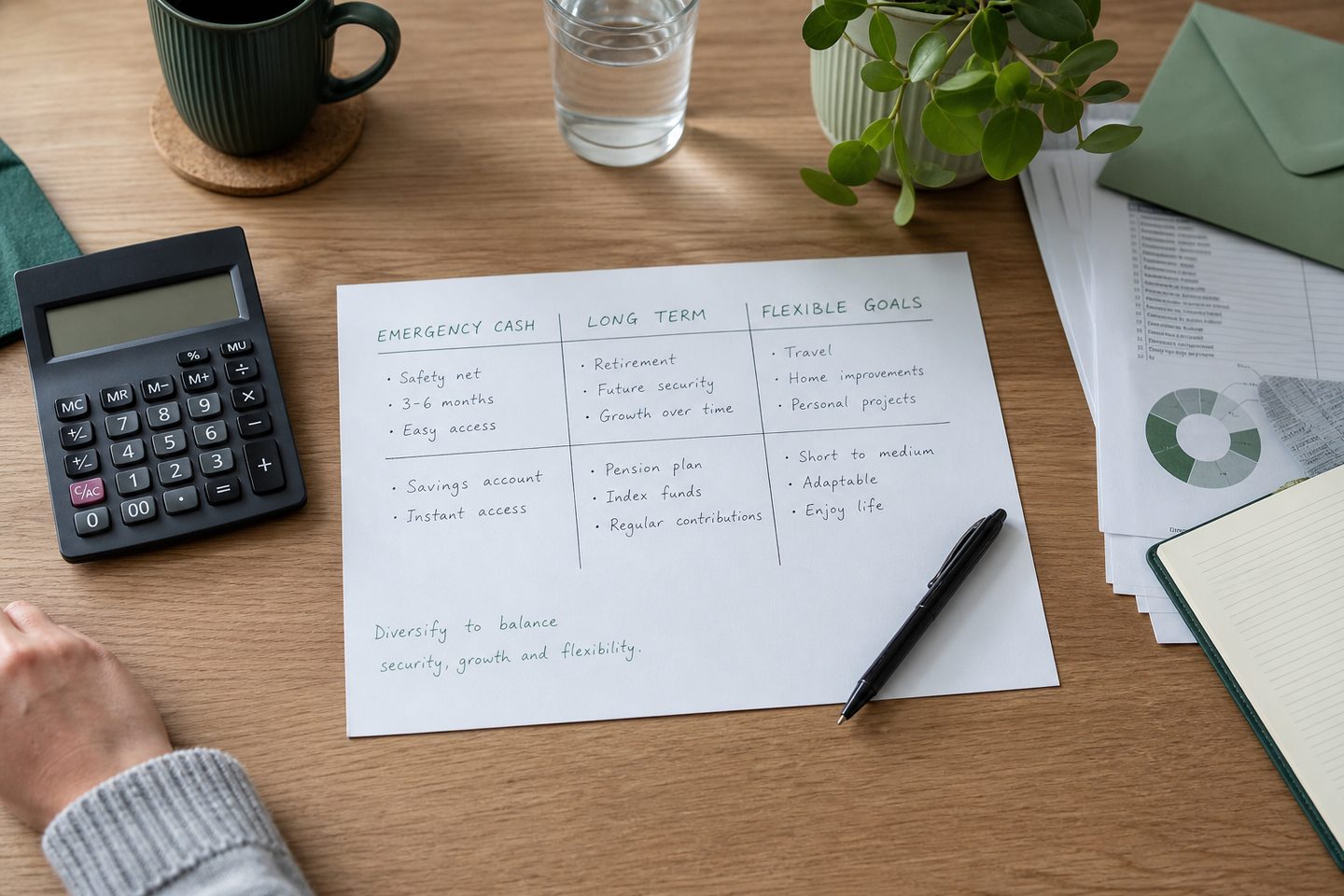
A household can look organised while every euro still competes for the same job. Rent, food, a broken boiler and a holiday fund are not one pile. When they share one account with no labels, the next surprise bill feels like a crisis even if the total balance looks healthy.
This is not a forecast and not an investment method. The useful question is narrower: which money must stay available this month, which money is allowed to wait, and which money should not be touched for a known purchase?
Most households are less organised than the balance suggests
Ask where leftover money sits and the answer is often singular: one current account. That is convenient. It is also why a large grocery week, a car service and an annual insurance renewal can collide. Familiarity with one account is not the same as knowing what the money is for.
Giving money a job means the next bill does not have to raid the money you already promised to something else.
Start with jobs, not products
Before comparing banks, cards or savings accounts, label each euro by its job. Day-to-day cash covers this week’s bills. A buffer covers disruption. Near-term savings fund known purchases. Longer-term savings can wait. Mixing these jobs creates forced decisions: an unexpected invoice becomes urgent only because the money earmarked for rent was already spent on something optional.
Three questions that decide a sensible split
- When might you need it? Money needed within weeks should stay in an account you can reach without delay or penalty.
- What shortfall would actually hurt? A theoretical “I can cut back” is less useful than listing the bills that cannot wait.
- How reliably does money arrive? Irregular income needs a larger buffer than a stable salary, even if the annual total looks similar.
Age matters, but the calendar matters more
A twenty-eight-year-old renting with a roommate and a fifty-five-year-old paying a mortgage can both need a one-month buffer. The difference is the list of non-negotiable payments and how quickly income would recover after a gap. Copying a percentage from a blog post ignores that list.
Write the next ninety days as a calendar, not a vibe. Mark rent or mortgage, energy, insurance, transport, childcare, debt minimums and any annual bill that falls inside the window. That calendar is more informative than a rule of thumb about “three to six months”, which may be too little or more than the household can fund yet.
Four practical buckets
Bills money is already spoken for. It should be boring and easy to see. If it lives in the same place as weekend spending, it will be spent.
Buffer money exists so a broken appliance does not become a high-interest balance. It is not for sales, upgrades or “I deserve this”. If you use it, the next job is to refill it before adding new goals.
Near-term money has a date: a deposit, a flight, a course, winter tyres. The date decides whether the money can sit in a slower account or must stay instantly available.
Later money can wait. Waiting is not the same as investing. It only means the household has accepted that this sum will not be needed for known bills. If that assumption is wrong, it is not later money.
How much buffer is enough for now
A useful first target is the cost of the most likely disruption, not an abstract number copied from another country. For many renters that is one month of essential bills. For a household with a car that is essential to work, add a realistic repair range. For self-employed income, add the longest plausible gap between invoices.
If the target feels unreachable, fund a smaller, named buffer first: boiler, dental, transport. A named €400 pot that actually exists beats a theoretical €6,000 pot that never starts.
Where the money sits is a second decision
After jobs are labelled, ask only then where each bucket lives. Same-bank sub-accounts, a second current account, or a plain savings account can all work. The test is operational: can you see the balance, move money on a working day, and avoid fees that quietly eat the purpose of the pot?
Do not chase a slightly higher advertised rate if it means mixing the buffer with money you might need this week, or locking it behind a notice period you have not tested. Read the withdrawal rules, not the headline rate.
What this is not
Separating buckets does not increase income. It does not protect against inflation on its own. It does not tell you which savings product is “best”. It only reduces the chance that one surprise uses money that already had a job.
Households with high-interest consumer debt should treat minimum payments and a plan to reduce that debt as part of the bills picture, not as an afterthought. Education pages cannot rank products for you; they can only remind you to read the total cost, not the monthly figure in isolation.
A one-hour setup
- List essential monthly costs from real statements, not memory.
- Circle the next 90 days of known extras: insurance, school, travel, tax.
- Name four buckets in writing, even if some start at zero.
- Move this week’s bills money away from the spending card if you can.
- Set a refill rule for the buffer: a date and an amount, however small.
- Record where each bucket lives and how you would access it on a weekday.
Review without rebuilding everything
Once a month, check whether money moved between jobs without a decision. That usually happens after a holiday, a sale, or a “temporary” transfer that was never reversed. The review is not a moral audit. It is a map update.
If income changed, update the bills list first. If a goal date moved closer, that money may need to leave the later bucket. If the buffer was used, the later bucket waits. The order is the point.
Common failure modes
Too many pots. Eight accounts with no names are worse than three named ones. If you cannot explain a pot in one sentence, merge it.
Shared households with private pots only. If two people pay different bills from different cards, the buffer still needs an agreed owner and refill rule. Ambiguity is how the same bill gets paid twice or not at all.
Optimising the last 0.2%. Shopping for a marginally better savings rate while the bills account is overdrawn is the wrong sequence.
Treating cashback as income. Rewards can vanish, change or encourage extra spending. They are not a bucket.
Questions to ask a bank or app before you move money
- Is there a fee to hold, transfer or close the account?
- How long does an internal transfer actually take on a Friday evening?
- Are there limits on how many sub-accounts or pots you can keep?
- What happens if the app is down and you need the money?
- Is the legal entity the one named in the terms, and is it covered by a deposit-guarantee scheme for eligible balances?
Verify those answers in the institution’s own documents and, where relevant, in the national deposit-guarantee information. A marketing page is not the document.
If you live across more than one country
Euro illustrations do not make every rule identical. Deposit protection, account switching, wage payment cycles and emergency housing costs vary. Keep a short note of which country’s bills are due in which currency, and do not assume a buffer in one country covers a liability in another without FX cost and timing.
Cross-border households should also record which person is legally on which account. Access during illness or travel is a practical question, not a pessimistic one.
Worked example without pretending it is your life
Suppose essential bills are €1,900 a month, a car service is likely within four months, and income is monthly salary. A first map might be: €1,900 in bills money already accumulating toward the next payday, €1,900 as a starter buffer, €400 labelled “car service”, and anything beyond that as later money. If the household cannot fund all of that this month, keep the labels and fill bills and a smaller buffer first.
The example is arithmetic, not advice. Change the figures and the order may change. A household with unstable hours might double the buffer before funding the car pot. A household without a car would drop that line entirely.
What to write down once
Keep a one-page note: bucket names, current homes, access method, refill rule, and the date of the last review. Store it where you store other household documents. The note is for you, not for a platform.
If you use a shared spreadsheet, protect it the same way you protect other personal records. A money map is useful; a publicly shared money map is not.
Before you act
Turn the reading into a written decision rather than an immediate switch or purchase. Note the job of the money, the earliest date it may be needed, and which bill would actually hurt if it were late. Compare at least two reasonable alternatives, including doing nothing for now. Record fees, notice periods and how you would access the money on a working day.
Then verify every provider through primary documents. Match the legal entity to an official register, read the latest terms, and keep a copy of what you relied on. Do not trust a badge, app-store listing or authorisation number shown in an advert. If the decision affects tax, debt you cannot service, housing or a large share of household resources, consult an appropriately authorised professional who can consider the full circumstances.